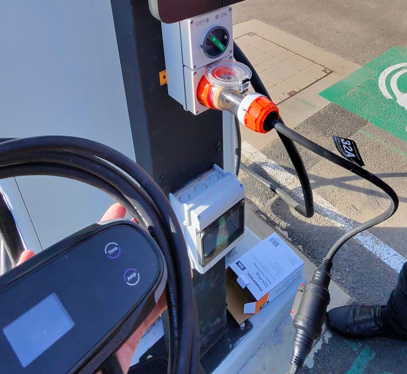
Powertech EV Charger
You’d be surprised how many Electric Vehicles do not come with a basic 220v mains-socket charger – even Tesla seem to expect everyone to already have one, or stump up $550! So, if your EV didn’t come with a 220v mains charger, and you want to charge from powerpoints everywhere that electricity exists, read on.
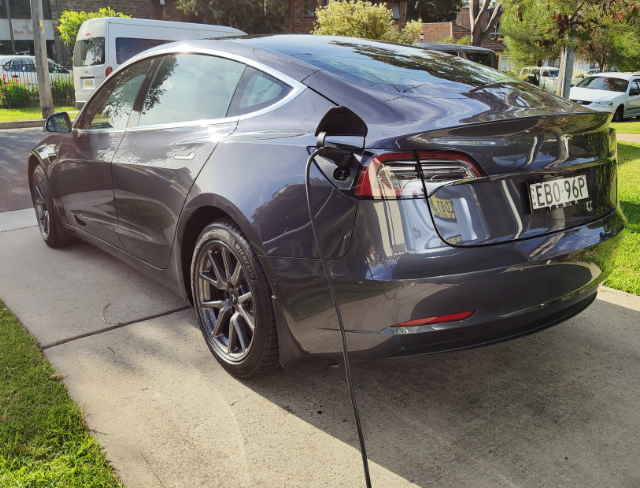
What kinds of mains sockets are there?
Charging from a mains power socket is usually the cheapest way to charge (outside of free chargers at workplaces and shopping centres). Yes, it’s slow, 12-50KM/hour, but power sockets are everywhere, and if you get yourself a off-peak EV-friendly energy plan, you can fill your battery for less than the price of a cup of coffee.
Mains sockets you are most likely to encounter in Australia have three types to choose from:
10A (the powerpoints in every house – an outside one might have a weather-proof cover)
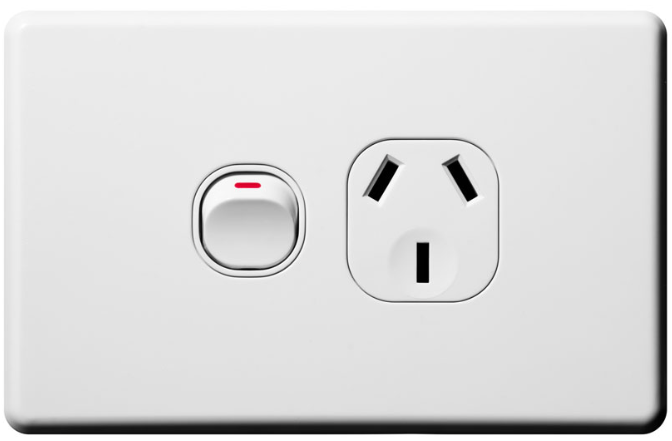
15A (looks similar to 10A, but with a bigger earth pin and a 15A rating)
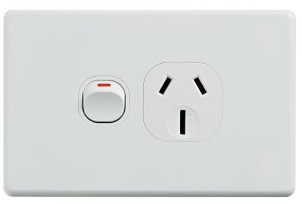
32A (usually found at caravan parks and commercial premises)
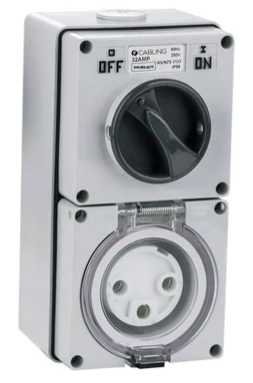
Of these, the 10A kind is usually good for 12KM/hour of charging, the 15A kind for 15-18KM/hour, and the 32A kind can go all the way up to 50KM/hour (observed in my Tesla, other EVs might be a little different).
But, doesn’t it takes ages to charge an EV?
Whenever someone asks this, my answer is “It takes less than 30 seconds to plug in and out”, because it doesn’t matter how long it takes, if you can do other things, like sleep, whilst it charges.
One of the hidden benefits of EVs is that you no longer need to queue up at servos and waste 5-10 minutes standing around squeezing a greasy pump handle that has been touched by hundreds of other people that day, just to get a weekly fillup of aged dino-juice.
Selecting a charger
Mains EV chargers sold in Australia should all have the same Type-2 EV plug on them, as this was the standard required by the government once EVs started to get rolling a few years ago – you do not need to worry about EV plug types if you bought a new EV in the last few years.
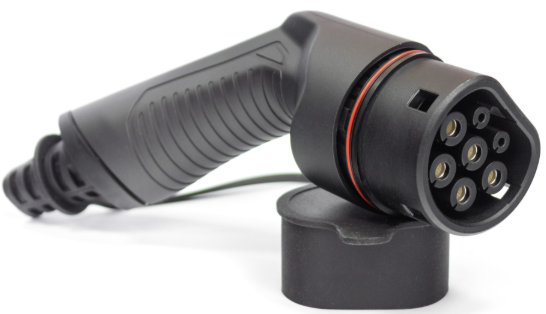
However, not all chargers will have the same mains-side capability to deal with 15 or 32A.
Ideally, you should pick a charger that either comes with the leads to connect to those 15/32A sockets (more expensive though) or has them available separately. That way, if you decide to charge mostly from mains, you can get a sparky to put in a 15A or 32A socket at your home, and avoid the slowest 10A rate.
Lastly, make sure any charger you select has been rated for Australian standards – many sold by overseas vendors on “marketplaces” usually have not, and are likely to be a problem in the event of an insurance claim.
The Powertech charger
I came across this particular charger (Jaycar’s code ME0003) at my daytime job – it rocked up in a nice fabric zipper tidy bag with Velcro strips to help it stick to the car boot liner. The cables are sturdy, and the box and cabling all look very weatherproof.
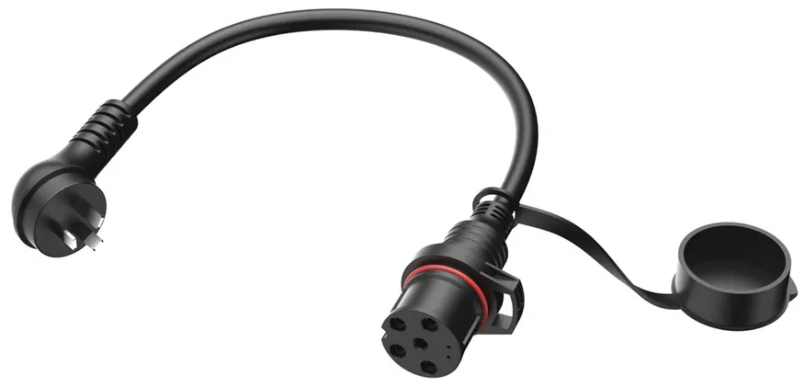
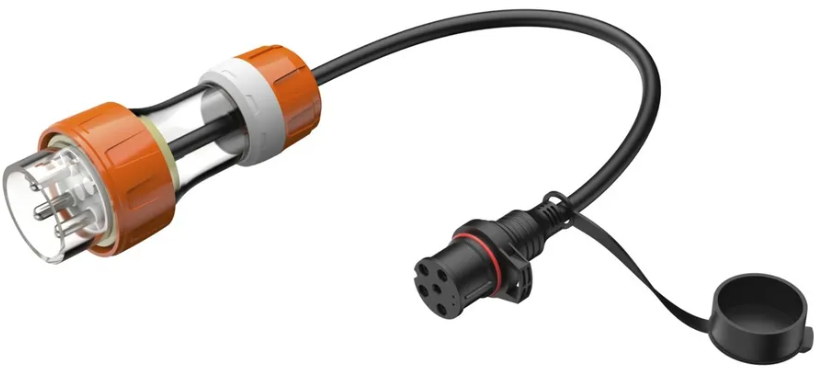
As supplied, it had 5 metre EV cable and a 80cm 10A “tail” in the package, complete with locking clip and waterproof seal. All exposed plug ends have tight rubber caps. A decent-Englished manual is included, and it is apparently designed in Australia to meet our local standards.
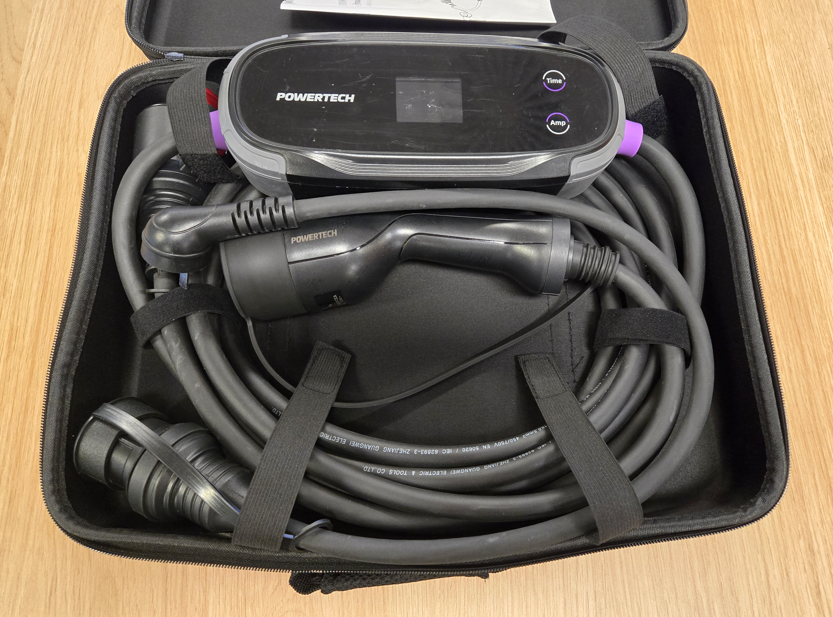
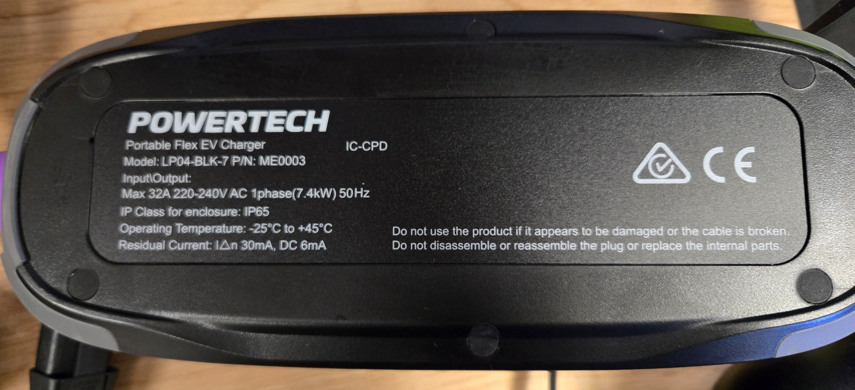
The 15A and 32A “tails” are available separately at Jaycar and RoadTechMarine stores as catalogue numbers ME0005 / ME0006.
How does it work?
For this charger, all you need to do is plug in to mains with the 10A tail, the display lights up, then plug it into your EV and walk away. There’s just two capacitive soft-touch buttons, which you do not have to use at all, but they do give you some additional functionality tweaks.
The Amps button gives you the option to select from 6, 8, or 10A whilst this tail is connected (the other tails let you select from those, plus 15A or 32A respectively, more on those later).
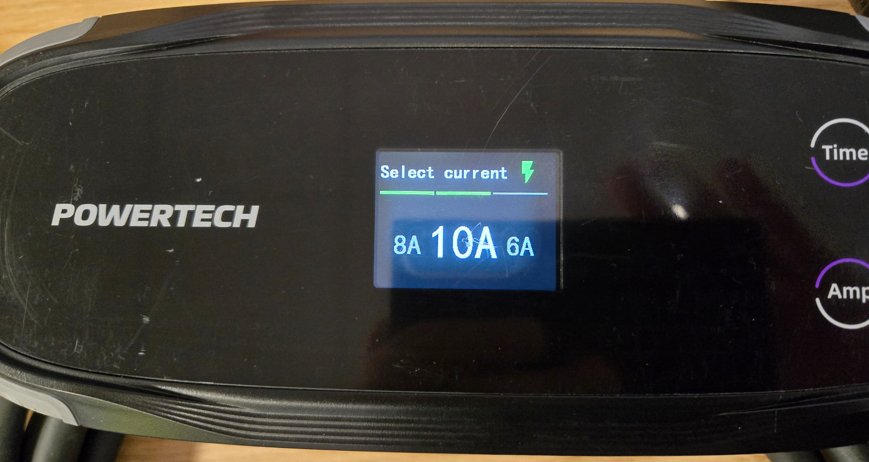
Why would you want less than 10A? Well, if you had solar power to charge from, and your EV isn’t smart enough to adjust its onboard charge rate to match your solar excess (Teslas can do this), then you can set a lower rate manually to not draw more than the solar system generates. Also useful if you are using a forbidden extension cord and want to avoid it getting hot and melting the plugs.
The Time button lets you tap through a set of start-delay times from 2 to 8 hours in 2 hour increments. Again, if your non-Tesla EV can’t control when to start charging, to match your solar output or off-peak electricity plan, this feature is useful to manually control the start time.
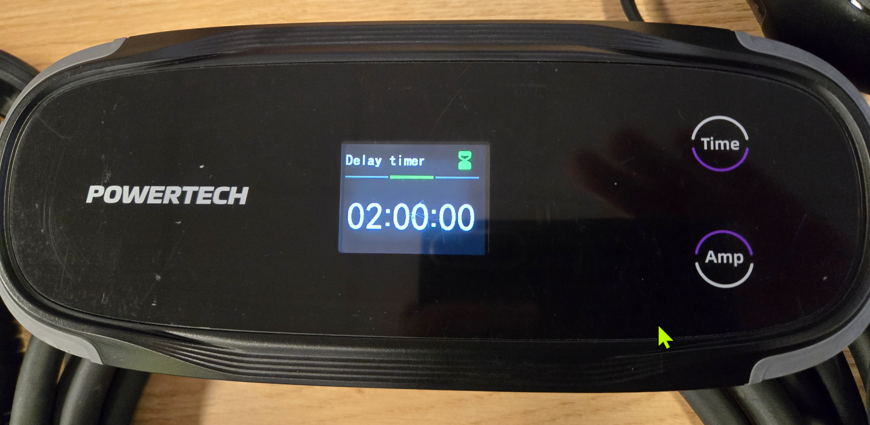
Both of these optional features need to be set before you plug in to the EV – they are locked out once the EV is connected to prevent fiddling.
Performance
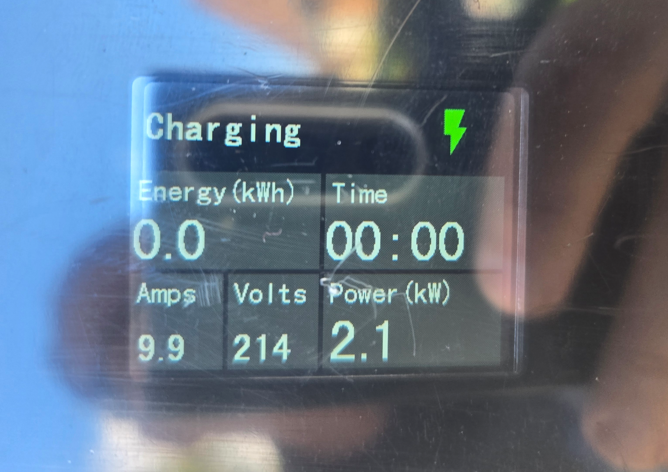
Plugged into 10A, the charger said it was delivering almost exactly that. The display will total up how much time and how much energy (kWh) your charge session consumed too – handy if you have to owe someone a beer for using their power! In the pic below, I was using a forbidden extension cord, so the voltage was lower than 220v.
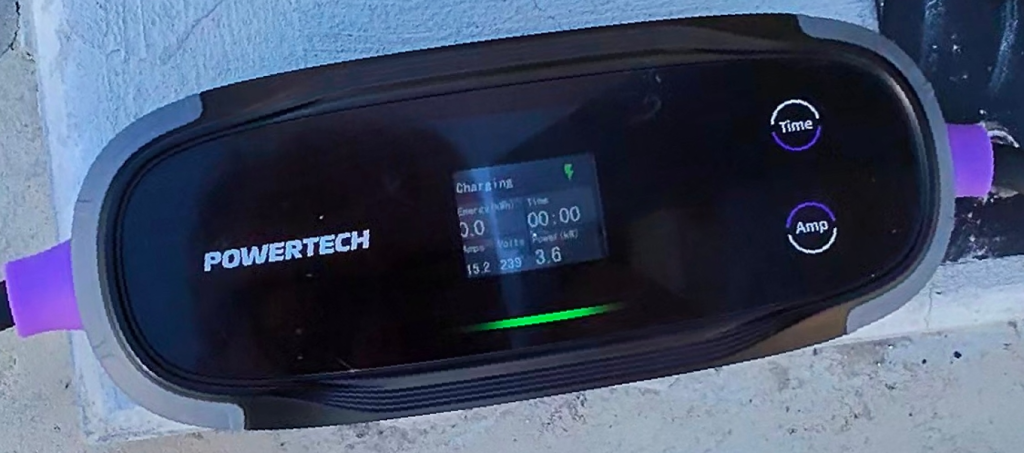
Swapped to the 15A tail, it delivered that too (3.6KW in this case, about as much as a big aircon draws).
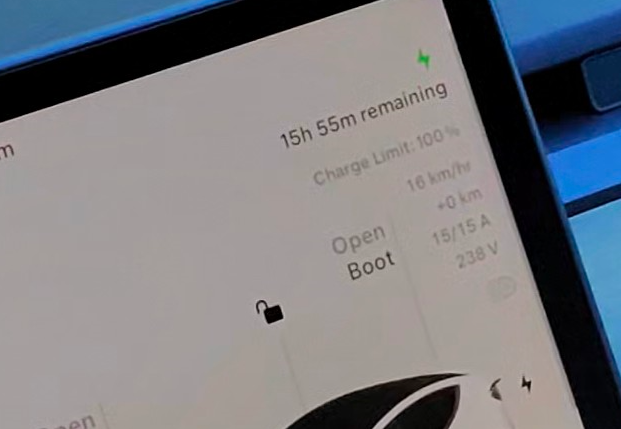
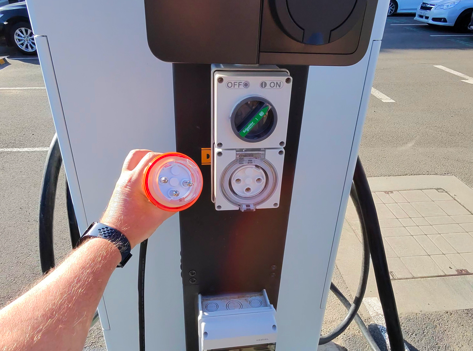
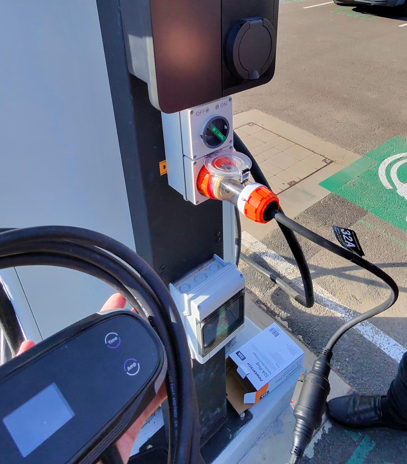
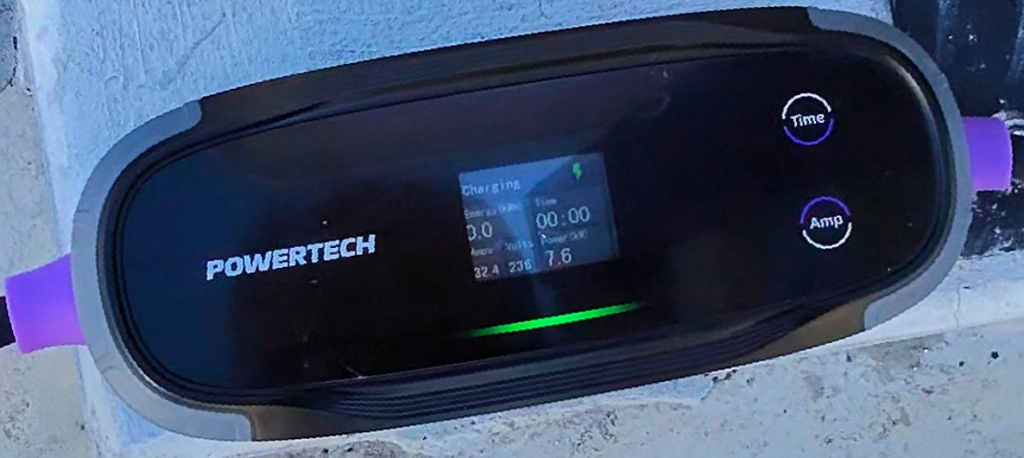
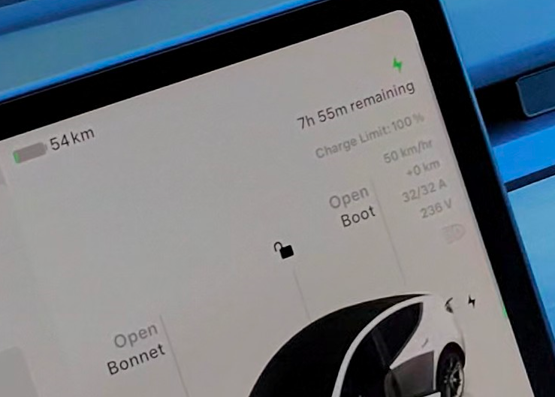
And, plugged into 32A using the stiff-to-insert 32A tail that has a locking ring, it delivered that as well.
Can it go wrong?
The cables and charger box are designed to work in the rain, so as long as you do not submerge them in puddles, they should be fine. The cables appear sturdy enough to survive being driven over as well.
The charger is tolerant of being accidentally plugged into the EV before you connect it to the mains – the only likely failure mode this might create is an error message if you changed the tail type from one to another before you plugged it in to the EV – unplug it from the EV, and plug in the mains first is the way to reset this.
The maker says it has overload, overcurrent, overheat and short-circuit protection, so it should be bullet-proof. Have not had a chance to try it on a 12v battery/inverter off-grid setup to see if it can run from batteries, but I expect that would not work – the charger likely has a earth-leakage detection function (like a RCD) that will not work with inverters, as they do not have earth pins. The efficiency losses of charging an EV from batteries by converting 12v to 220v with an inverter would be terrible anyway.
Is it value for money?
This one is $449 – less than a $550 bare-bones Tesla charger, which has no display, power stats or user settings. It’ll work with any recent EV, though not with older Nissan Leafs, Mitsubishi PHEV / iMIEV or Tesla S/X, which do not have Type-2 plugs.
A 15A tail is $100, which brings the total up to the same price as the Tesla charger. The 32A tail is $200 – equivalent tails from other brands are $150-$180. Even with the extra tails, this is still a lot less expensive than buying a fixed 32A wall-charger, which would usually go for $1000 and up.
The charger is backed by Jaycar, so you get the security of a 2-year warranty with stores nationwide, capable of honouring that warranty.
